Bookseeker Literary Agency

Introducing authors and publishers.


HoneyMead Books wants authors

logoHoneyMead Books in South Africa is looking for authors of good quality, adult-themed fiction for its e-book list. Do you have a penchant for the off-beat, the wacky, the graphic, the horrific, or the bizarre? Or do you perhaps have something serious to say about LGBT issues, gender, sexuality and so on? Or do you perhaps have a novel where the violence is no-holds-barred? Send your synopsis and sample chapters by email to this agency, and we will select a few to send onwards to HoneyMead. They’re not looking for gratuitous violence or meritless pornography, but they are prepared to accept material aimed specifically for an adult readership. All work published will be sold subject to age-restrictions. The categories they are looking to publish in are:

  • Twisted humour & Satire.
  • Crime & True Crime.
  • Sensual, Romance, and LGBT.
  • Arcane magic, Fantasy, and Paranormal.


Why Vampires? An interview with Marie Marshall, author of ‘From My Cold, Undead Hand’.

FMCUH cover 200We recently had the opportunity to talk to Marie Marshall about her teen-vampire novelette From My Cold, Undead Hand. The book is scheduled for publication on 15th September, and will be available first of all as a download direct from the publisher. Shortly after that it will be available in Kindle format and print-on-demand from Amazon, and in due course there will be a bookshop launch. So fans of YA and vampire fiction can beat shopgoers to the book by buying pre-launch copies! What is more, early purchasers will be able to claim some bonus extras! This novel marks quite a departure for Marie; although she is well-known in Scotland for her macabre short stories, this is the first time she has tackled the vampire genre. We wondered why, so we asked, and her answers brought out more questions.

Why vampires?  Tell us what brought this novel on.

What brought it on was an email from my trusty publisher, asking if I could write a teen-vampire novel. I took that as a request to write one on commission and just hurled myself into it.

There are many well-known writers of vampire stories, from Bram Stoker to Stephenie Meyer, so much so that it is a well-subscribed – some would say over-subscribed – niche of adult, teen, and graphic literature. What makes From My Cold, Undead Hand different?

Honestly I wouldn’t know. I have read Dracula of course, and Joanne Harris’s The Evil Seed, but very little else; oh, and watched Buffy the Vampire Slayer and Angel of course, and many of the old Hammer films. I have always avoided Twilight – you can call that prejudice if you wish. I’m very familiar with vampire images and myths, but I guess I must have absorbed this knowledge through some kind of cultural osmosis!

What I set out to do was just to write a story, most of it set in near-future with dystopic elements but with a nineteenth-century back-story I already had notes for. I cited a couple of obvious influences in the acknowledgments section of the book, but by-and-large my aim was to write a good story, almost as though the vampire theme was incidental. You could say that the true theme of the book isn’t all the vampire action, but the way that young people can get marginalised in an adult world. I think all writers of genre fiction ought to focus on writing the story first of all, and to hell with the conventions of the genre, if you see what I mean.

Tell us about Chevonne Kusnetsov your heroine.  You mentioned that you like heroines to be young, strong-minded females.

Isn’t that the definition of ‘heroine’ anyway? I’ll take it that you mean ‘female protagonist’ if we’re going to generalise here. I do tend to write female protagonists that that are young and strong-minded – Eunice and Jelena in Lupa, Angela in The Everywhen Angels – I don’t know of that many major literary female characters who aren’t young and strong-minded. Well, maybe Bridget Jones, and maybe some of the women in the older Mills and Boon novels would be a bit limp, but not even they would be total dead losses. It is, of course, a literary convention to make your protagonist someone admirable, so that the reader can identify readily with that character. That’s reinforced by the first-person narrative.

Chevonne is, I suppose, a tomboy character. I wanted someone with whom young female readers could identify, but who wouldn’t alienate young male readers. I guess in many respects she is asexual. She certainly has other things on her mind than dating and what-have-you. I didn’t want her to be a Bella Swan – she’s closer to Buffy than that, but with a spiky haircut – so any hint of romance is very low key. But it does crop up, just wait and see.

I think one of the main reasons I needed her to be strong-minded was to highlight that theme of marginalisation I mentioned. Without giving too much away, I can tell you that her decisiveness doesn’t actually move the plot along, but rather she is swept along in it. Two of her most important decisions in the story actually have disastrous consequences for people close to her.

Did you know her surname is the Russian equivalent of ‘Smith’, by the way?

Tell us more about Dianne, Chevonne’s friend.  

Di is easily led and, true to the theme of the book, easily marginalised, even by someone she loves. There’s a kind of gaucheness about her. There is a good reason why she sticks to Chevonne, and maybe a good reason why Chevonne sticks to her (although I deliberately don’t make that clear). She’s the character in the book whom I most want to cuddle and tell her everything is going to be all right, but of course… ooh… spoilers, spoilers!

I believe that anyone who pre-orders From My Cold, Undead Hand or is quick off the mark buying it, will learn more about Di from some extra material that I have written.

Chevonne’s mother is a bit of a shadowy figure.  Are you planning to develop her at some point?

I wasn’t planning to, no. One of the things I did in writing this story was to focus on essentials, via the mind of the protagonist. So much is happening in the story that her mother is hardly on her mind, so she remains shadowy. It’s a part of Chevonne’s character, which is why I guess she doesn’t see the possibly consequences of some of her actions. Add to that I didn’t want Chevonne’s mother to become a kind of Joyce Summers figure (from Buffy), so I deliberately kept her out of most of the story.

Having said that, now that I have written the extra material about Di, I can see the potential for taking figures from the novel and writing short stories about them. Maybe stories not directly connected with the novel.

Every author writes him/herself into the story at some point.  Which character do you associate with most, and why?

I don’t do that. What I do is mine my own feelings and put them into characters. I’m not Chevonne, I’m not Di, I’m not Miureen, I’m not Anna Lund.

I did do a bit of kick-boxing when I was young, like Chevonne, though. I’ll say that much.

The dystopian future you describe.  Is this based on political views you hold or want to present?

Not particularly. I think that trying to do that spoils a book. For me, John Wyndham’s anti-religious stance coloured his science fiction novels too much, as did C S Lewis’s Christian triumphalism. Even Tressel’s The Ragged Trousered Philanthropists doesn’t quite work. You have to be a Dickens or an Orwell to get away with it. What I did was simply imagine a handful of modern trends and made them a little worse, and that was mainly to create a backdrop and context against which and in which the action could take place.

Which elements of that future, do you feel, will most probably eventually happen?  

Well, as they are based on what is already happening… I think the strongest element is the manipulation of government and other institutions by unaccountable forces. The only difference is that they’re not vampires doing it at present. At least I hope not!

You set the action in America. Was there any reason for this? Do you think you have successfully captured a kind of American-ness in the novel?

Well firstly to market the book! Secondly I wanted to have the gun issue as an element. It gave me such a good title, which I appropriated from an NRA slogan. Before you ask, the story is neither pro-gun nor anti-gun. Guns are simply a fact in the novel, and although there are unforeseen consequences upon gun ownership laws from one of the major elements of action, that isn’t moralised upon. I guess anyone with strong pro or anti gun opinions will assume I’m on one side or the other, and I don’t mind if they do if it helps to promote the book!

As for American-ness, well that’s secondary. As I said, I focussed on what was uppermost in the protagonist’s mind, and that wasn’t giving chapter and verse about the Statue of Liberty of the Golden Gate Bridge. To help me with aspects of day-to-day life and expression I had a couple of American ‘beta readers’. I did have a battle with my editor over one vernacular phrase which he said was only heard in the mouths of the ignorant and would pass away. I conceded, but since then I have heard Hilary Clinton use it, so I’m claiming a moral victory!

Is there a future for the storyline?  We heard noises of a sequel being under construction?

Yes, a sequel is more than half-completed. Without giving too much away, I have moved it forward, so that what we are going to learn about the storyline from From My Cold, Undead Hand we’ll get in back-story. There will be one important character, however, whom we shall meet again in the sequel. There is also a ‘threequel’ planned, though I have to confess the plot is going to be a bit tricky.

Having had this success with vampire fiction, is it something you are going to stick with beyond the planned trilogy?

Heavens, no! Sorry, I didn’t mean to sound so vehement there, like I’m slamming the door shut on vampire fiction. Obviously if a good story occurs to me I’ll write it. What I really meant was that I had put aside three ideas for other novels – partly written in some cases – in order to write this teen-vampire trilogy. I would like to go back to them, and get back to writing primarily for an adult readership.

Is there an essential difference between writing for adults and writing for young adults?

Oh that actually puts me on the spot. No, there isn’t. You can’t ‘write down’ to either. If anything, though, younger readers are less tolerant of superfluity, more acutely observant of inconsistencies, sharper in their use of their critical faculties – mainly because they haven’t yet been taught how to misuse them.


Updates on Marie Marshall’s ‘From My Cold, Undead Hand’

promo05a

The passage is from the story-within-a-story, a translation of a rediscovered, nineteenth-century manuscript said to be the writings of a female vampire-hunter. You will find it embedded in Marie Marshall’s futuristic teen-vampire novel From My Cold, Undead Hand, which now has its own feature page at FMCUH cover 200P’kaboo publishers. Just click the book cover to be taken there. There are extras – text and an audio file from the diary of one of the characters – for a limited number of purchasers. For those of you who would like a paperback version in advance of any domestic print launch, you can get it at Amazon – same goes for a Kindle version.

The author, along with cover illustrator Millie Ho, are offering a couple of wallpapers using the cover artwork. They are available here.

We at the agency are getting very excited about the publication of this teen-vampire novel! As with all titles from P’kaboo Publishers in South Africa, the publisher is keen to find ‘partner’ publishing houses in the UK, the USA, and worldwide who would like to make this novel available to a wider readership. Please contact this agency for further details.


Publication date for ‘From My Cold, Undead Hand’ announced!

twitterbanner 2 blog 2

Yes, P’kaboo Publishers have announced the date on which Marie Marshall’s long-awaited teen-vampire novel From My Cold, Undead Hand will be available from them in e-book form. Other forms will become available later, but for those readers with the facility to read the ePub format, buying direct is the way to go. You can pre-order, and as a bonus the first twenty-five purchasers will receive extras, including audio material!

The story itself is fast paced and gripping. The protagonist is Chevonne Kusnetsov, a teenager from New York City a generation or so into the future. The ecology is in crisis, electricity is scarcer and mainly generated by wind turbines mounted on top of buildings. Meanwhile, vampires stalk the dimly-lit streets after dark. But their very existence is denied by the government and the media. Expose!, a shadowy organisation formed to blow the vampires’ cover wherever it can, is routinely denounced for conspiracy-theory, anti-semitism, and downright insanity. The Resistance, a secret guerrilla army of vampire-hunters, organised in a cell-structure, is denounced as a ‘terrorist’ organisation. Chevonne has been recruited to the Resistance by her history teacher, and she’s tough – straight from the school kick-boxing club, she can use her fists and feet, but also a sword, a stake, and a laser-gun. What is the vampires’ ultimate plan? How does it involve the government? How does it affect Chevonne and her friends Di and E.J.?

The title, From My Cold, Undead Hand, is adapted from a famous slogan popularised by the National Rifle Association in the USA in defence of the right of American citizens to own and carry firearms. One of the features of the novel is that vampires, who in traditional fiction arm themselves with nothing but their teeth, exercise this constitutional right. Well, so do the vampire-hunters! By the end of the book there is a twist to this ‘right’. I asked Marie if her novel was deliberately politicised or partisan on this issue.

No, indeed not, but it did occur to me to introduce gun-carrying vampires and to have elements of the plot which developed the consequences of guns in this kind of conflict or adventure. Of course I have my own views about the issue, but there are two points I’d like to make. Firstly, I’m not American, and it’s America’s call. And secondly, no author worthy of the name lets her own views affect the way a plot is developing. The story goes how the story goes and that’s that. Anyhow it’s not ‘about’ guns. If it has a theme it’s about how young people tend to be marginalised.

That theme turns the dramatic crisis of the novel into a cliffhanger, leaving readers wanting more. Thankfully a sequel is half-written already, and there is even the possibility of a threequel. So who should read it?

It’s pitched at ‘young adult’ level, but it’s not ‘written down’. I think it will be snapped up not only by teenage readers but by adults who are into vampire fiction – and there are many, many of them ‘out there’. I just hope people out there will enjoy the ride as much as my ‘beta readers’ did.

From the point of view of this agency, it is encouraging that P’kaboo have shown faith in Marie once more, and are publishing her third novel on the 15th of September. Keep a watch for updates here, and by following @ColdUndeadHand on Twitter. Don’t forget that you can pre-order your copy!


Watch out for ‘From My Cold, Undead Hand’!

Our client Marie Marshall was asked by her publisher if she could write a teen-vampire novel, and her answer was simply to write one – From My Cold, Undead Hand. She told us:

It’s both an easy and a difficult genre to write in. It’s full of ready-made tropes and pre-existing vampire ‘lore’, and of course it has a cult-genre following of highly critical fans. Basically a writer has two choices: Buffy or Twilight. By that I mean one has to chose between writing about vampire hunters, or teenage romances with vampires. Then one has either to avoid cliché… ahem… like the plague, or embrace the clichés and go nuts with them.

So, which story-line has Marie decided to go down?

Well, I chose the vampire-hunter angle, as it gave me the opportunity to create a strong, young, female protagonist.

FMCUH bookseeker imageMarie is adept at those strong, female protagonists – Jelena and Eunice in Lupa, Angela in The Everywhen Angels, and now Chevonne Kusnetsov, a girl from New York a few decades in our future, in From My Cold, Undead Hand. The novels launches straight into action, with Chevonne in a darkened library, defending her dying mentor from the attack of a powerful vampire ‘sire’. Spiced here and there with hints of ITpunk and steampunk, and complete with a nineteenth-century sub-plot revealed in an old book, the pace of the novel never flags. It shuts with a bang – readers will blink and say “Huh?” – leaving a perfect springboard for the sequel, KWIREBOY vs VAMPIRE, which is already being written! Ostensibly dealing with the constitutional right of vampires to carry guns, the novel in fact foregrounds how young people are routinely marginalised. So, has she succeeded in avoiding cliché?

I hope so. I’ve tried to be innovative whilst leaving enough there that is familiar.

In fact when we read through the manuscript we noticed some cheeky inter-textual referencing. Readers will be surprised to find out who’s included in Chevonne Kusnetsov’s remote family tree, for example. Readers familiar with, say, Bram Stoker or Stephenie Meyer may spot some ‘Easter-eggs’, though Marie cites as her main influence Joe Aherne’s TV series Ultraviolet.

Adding to the impact of Marie’s prose will be cover art again by Millie Ho, the talented Canadian artist and writer, who provided the cover for The Everywhen Angels. This is a book to watch out for, one not to miss. As soon as there’s a launch date we’ll let you know. Follow the action on Twitter @ColdUndeadHand.


Available for publishers: ‘Split Decision’ by Carmen Capuano

split decisionMy name is Natalie and I am almost sixteen years old. I didn’t know what to do when two boys asked me out on the same day and I didn’t realise how little I knew about life at the time… but I made my decision and now I have to live with the consequences…

That, in a nutshell, is how Natalie, the protagonist of Carmen Capuano’s YA/crossover novel Split Decision, would introduce herself.

Natalie knows she has some decisions to make. Should she date the boy next door or the other one, the one who looks as if he plans to set the world on fire? What she doesn’t know is that the wrong decision will send her life spiraling into the stuff of nightmares where she might not come out alive.

Life takes a cruel twist of fate when Natalie, a completely average [almost] 16 year old is forced to make a split-second decision…a decision that will change her future and forever alter her perception of trust, love and the realities of life.

Split Decision could be thought of as ‘a modern take on Sliding Doors with a teenage edge’. It’s a novel of contrasts, of humour and dark despair, where difficult themes such as rape and drug abuse are written of in a style that is gritty but never gratuitous, coming via numerous plot twists to a surprise conclusion. It is written from the heart and tells a tale of what may be, in a world that is increasingly dangerous for all, but especially teenagers and fledgling adults.

Author Carmen Capuano is a live wire, and the agency is very pleased to be presenting Split Decision to UK publishers. Just get in touch and ask to see sample chapters, a synopsis, etc.

Heeyy! Carmen meets The Fonz! Author Carmen Capuano pictured with actor Henry Winkler.

Heeyy! Carmen meets The Fonz! Author Carmen Capuano pictured with actor Henry Winkler.


P’kaboo Publishers – looking for publishing ‘partners’ in the UK, the USA, and worldwide.

P'kaboo banner

Part of the ‘mission’ of South African indie publishing house P’kaboo is to be a springboard from which to launch authors to bigger things, to be the first step for an author in getting himself or herself noticed by mainstream publishers in the wider world, particularly in the UK and USA. With that in mind, this agency, as the UK representative of P’kaboo, would like to bring three books to your attention.

Each one is available on request, for consideration by any commercial publisher in the UK, the USA, or worldwide. Just email this agency!

Although the three books here may all be classified generally in the ‘fantasy’ genre, this is only one of the strings to P’kaboo’s bow. Their list includes a range from children’s books to music manuals.

Blank bookcover with clipping pathSolar Wind I: The Mystery of the Solar Wind
Lyz Russo
This is the first of a series – the author has completed No.IV – and the most obvious place to start. Although this novel and its sequels may fit the ‘fantasy’ genre, this one may be thought of rather as a mystery novel in a futuristic setting.

The year is 2116. Captain Radomir Lascek sails his pirate ship, the Solar Wind, around the oceans, collecting outlaws and fugitives and dodging the authorities. But then he hires three young musicians in Dublin – the Donegal Troubles. Radomir Lascek, with all his wily schemes, is about to learn the real meaning of ‘trouble’.

Here is what some readers and reviewers have had to say. Firstly in the Father’s Day issue of South Africa’s Your Family magazine:

Mystery of the Solar Wind… is a heart-warming and sometimes breath-stopping tale of murder, flight, and friendship. The Solar Wind’s crew is more than a motley one. They are a bickering, eccentric clan, full of shenanigans and loyal to the death… which might just be around the corner.

Fran Lewis, book reviewer and author of the Bertha series, says:

Secrets, mysteries, lies, deceptions, intrigue and murder are just some of what you will encounter when you board the Solar Wind for your journey into the 22nd century. This will not be just any ordinary journey, it will keep you spellbound, alert, terrified, inquisitive and more, about the new world powers of the year 2116 and just what changes are in store for you. With a cast of characters so diversified, yet so alike, you will want to not only learn the reasons why each crewmember signed on to the Solar Wind, but go along with them on their dangerous journey to find freedom and safety in a world filled with fear.

Other readers say:

The fast-moving and often surprising action leaves one quite breathless, rather like gypsy music played at a rousing pace. Yet one has time to get to know the characters, so that one can’t help but be drawn into their differing mind sets. Interesting how these diverse characters are tied into an intrinsically functioning unit, without the reader even noticing the natural ease with which the author does this. – The book raises some thought-provoking questions and leaves one looking forward to more from the pen of this intriguing author.

This book is a definite must-have for your library. A gripping tale from beginning to end, with characters so vividly described and with such varied and interesting personalities (one can’t help thinking of them as friends), you feel as though you know each of them personally. After reading this book all I can say is – Ahoy! Off to the next adventure!

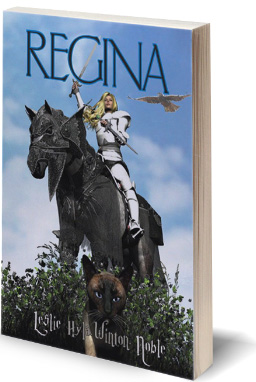
ReginaBlank bookcover with clipping path
Leslie Hyla Winton Noble
Beautiful and brilliant young Lady Regina-Valerie, only child of a wealthy lord, has everything. Everything, that is, except friendship and happiness. Her Siamese cat Tickle has a lot to say, but not much she can understand … until suddenly, she does. Then she is swept from her modern world into a wild adventure in the Warrior Magic Circle land where war is the main thing and ‘non-combat creatures’ like women are looked down upon. She and Tickle are kept very busy in a battle not only against evil forces and terrifying creatures, but also against the silly customs. To top it all, Regina has to fight with her own nature. After combating overwhelming obstacles with the help of a prince and princess, a wolfhound, a shy Scottish admirer, horses, and a martial eagle, she and Tickle are set the task of solving an impossible conundrum and tracking to his lair a malevolent creature powerful beyond imagining.

Fantasy lovers of all ages will be captivated by the excitement, humour and imagination in this epic tale of a quest with a difference.

cover - angelsThe Everywhen Angels
Marie Marshall
In these turbulent times with everything streaming towards its final demise, who can be a normal kid and simply go to school? Caught in the maelstrom of events in what may be the ‘Last Days’, the Angels are there when they are needed, preventing accidents, saving lives. They feel like heroes, invincible… until things start going wrong. Their story is told through the eyes of three youngsters from a comprehensive school on the outskirts of London. Angela is a poet, a rebel, and a questioner of how things seem. Charlie is a boy with great dreams, but who seems unaware of the troubles of his own mind. Ashe is young, strange, and very special. Join them as they uncover more questions than answers.

Scottish author and poet Marie Marshall wrote this novel for teenagers as a response to a challenge to set a fantasy in a school, and produce a novel as good as anything that a certain famous and wealthy compatriot of hers could write. Well, mission accomplished… and maybe even exceeded!

Here are some reviews and comments. Firstly from Nikki Mason at BestChickLit.com:

Three extraordinary kids. Three astounding stories. What will you believe?

Angela is just an ordinary teenager until the day she falls through a fence at school into the alternative reality of the Guardian Angels, a group of twelve teens who are tasked with protecting people in the build up of the final war between good and evil. But no one will answer Angela’s question: why?

Charlie knows he is special. Of course he’s a Guardian Angel. But he is also a Yellow – the GA’s rivals who try to prevent all their good work. But why is everyone suddenly ignoring him?

Ashe is diagnosed with Aspergers Syndrome and yet he can open doors between worlds and time. He understands what it really means to be a Guardian Angel but can he cope with the knowledge alone?

Marie Marshall tackles big subjects in The Everywhen Angels from religion and science to war and politics. All this rages on in the foreground of the lives of three teenagers who are trying to find their place in their world and be comfortable in their own skin. Action packed, full of crazy tangents, incredible ideas and stunning description, the novel is completely different to anything I have read before. It can at times be confusing, but bear with the story – the mind-boggling themes and plot diversions will be explained and will feed the curious minds of young adults.

Other readers say:

Writing of this quality ought to win the Carnegie Medal or something.

Straight up, no bull, the best book for this age-group that I have read in a long, long time.

The book is something special. The characterisation is convincing. The narrative is entertaining and gripping, but at the same time shows a wealth of knowledge and research and introduces challenging food for thought on abstract matters.

The Everywhen Angels by Marie Marshall is told through the eyes of three different teenagers in a school somewhere in England, as they take on the function of angels. They discover along with a small band of others that they have supernatural abilities which they are obliged to keep secret, however. How they put these abilities to use, for good or bad, that is the matter of the story. This book challenges its reader to face deep, existential questions; about life, the nature of the universe, the ‘ending times’ and what they mean (from several different perspectives); what is good and what is bad, or is there, and if so, by which right or logic do we interfere in what happens to others. The story left me feeling somewhat rattled and as though my cupboard of philosophies has received a good airing and spring-cleaning, and I now need to put things back and decide what to keep.  It is an excellent book; one of those ‘clingy’ ones that stays with you for days after because you have to think about it.

It’s tough to capture the sheer suspense of this book in mere words.

If you would like to know more about P’kaboo Publishers please feel free to visit their web site. There you will find details of their entire list, plus other information. If there is anything else you would like to know please contact this agency or P’kaboo direct.

Stop Press!
Due out soon – Marie Marshall’s From My Cold, Undead Hand, a non-stop teen-vampire story, the first of a planned trilogy. More news as we get it…


Luke Bitmead Bursary

Bitmead1

The Luke Bitmead Bursary is an annual award set up to support and encourage the work of fledgling novel writers. The award, now in it’s 7th year, is the UK’s biggest prize for unpublished authors. Read all about it at the Legend Press blog. Submissions are now open for the 2014 award. 

Luke Bitmead 300dpiThe bursary was set up by Luke’s family shortly after Luke’s sudden and tragic death in 2006, aged just 34. Luke was the first novelist to be published by Legend Press, who are delighted to work with Luke’s family each year on the award to honour his memory and help reduce the stigma attached to mental health issues. The top prize is a publishing contract with Legend Press, as well as a £2500 cash bursary.

Luke is the author of the brilliant White Summer, and also two novels published posthumously: The Body is a Temple and Heading South (co-authored by Catherine Richards). Information about Luke can be found at his web site.

If any of you do enter into correspondence with Legend, please don’t forget to mention where you heard of this. Thanks.


‘The Everywhen Angels’ by Marie Marshall – now available worldwide!

Angels Amazon coverMarie Marshall‘s stunning second novel, The Everywhen Angels, is now available worldwide in print and in Kindle format from Amazon, and direct from the publisher in eBook form. P’kaboo Publishers, for whom this agency is the UK ‘face’ is an indie publisher from South Africa. Though they might not have the clout, nor the advertising budget, of larger companies, they are in no way a ‘vanity publisher’. They offered Marie a commercial contract for her first two novels, Lupa, and The Everywhen Angels, and commissioned her to write a teen-vampire novel (From My Cold, Undead Hand – possibly to be published later in 2014). However, as a small publisher, P’kaboo acknowledges that it is in many ways a ‘first step’ for authors, and that if they can have their books taken up by one of the larger publishing houses then they should do so. P’kaboo’s blessing to them and recommendation to the other publisher can be taken for granted.

So, this agency’s next task is not only to promote the novel to readers, but also to UK publishers – starting here and now. If you’re reading this and are from a publishing house in the UK, the USA, or anywhere in the English-reading world, you have your next  YA best seller right here!

The novel was written in response to a lively discussion Marie Marshall had with friends about the merits of a series of books by a fellow Scot, set in a school for wizards. Responding to a challenge, she wrote an intriguing story, full of twists and turns, setting it in a Comprehensive school somewhere on the outskirts of London, in which groups of teenagers appear to find themselves coming together to skirmish on what might turn out to be the battlefield of Armageddon. But does this really have anything to do with the ‘End Times’? They struggle with teenage problems – relationships, bullying, parents, and each other – whilst trying to make sense of a world in which sense becomes harder to grasp. The plot twists, turns, runs backwards, contradicts itself, asks very deep philosophical questions, but still turns out to be enthralling and enjoyable. The author takes risks with it, but she says: “I believe children can handle difficult philosophical questions. They can handle stories told in a strange way. Young readers are much more intelligent than adults give them credit for.

Publishers – get in touch, don’t let this opportunity slip by. Here are some comments about the novel.

Nikki Mason at BestChickLit.com says:
“… Three extraordinary kids. Three astounding stories. What will you believe? Angela is just an ordinary teenager until the day she falls through a fence at school into the alternative reality of the Guardian Angels, a group of twelve teens who are tasked with protecting people in the build up of the final war between good and evil. But no one will answer Angela’s question: why? Charlie knows he is special. Of course he’s a Guardian Angel. But he is also a Yellow – the GA’s rivals who try to prevent all their good work. But why is everyone suddenly ignoring him? Ashe is diagnosed with Aspergers Syndrome and yet he can open doors between worlds and time. He understands what it really means to be a Guardian Angel but can he cope with the knowledge alone?

Marie Marshall tackles big subjects in The Everywhen Angels from religion and science to war and politics. All this rages on in the foreground of the lives of three teenagers who are trying to find their place in their world and be comfortable in their own skin. Action packed, full of crazy tangents, incredible ideas and stunning description, the novel is completely different to anything I have read before. It can at times be confusing, but bear with the story – the mind-boggling themes and plot diversions will be explained and will feed the curious minds of young adults…”

Other readers comment:

“… the book is something special. The characterisation is convincing. The narrative is entertaining and gripping, but at the same time shows a wealth of knowledge and research and introduces challenging food for thought on abstract matters…”

“… The Everywhen Angels by Marie Marshall is told through the eyes of three different teenagers in a school somewhere in England, as they take on the function of angels. They discover along with a small band of others that they have supernatural abilities which they are obliged to keep secret, however. How they put these abilities to use, for good or bad, that is the matter of the story. This book challenges its reader to face deep, existential questions; about life, the nature of the universe, the ‘ending times’ and what they mean (from several different perspectives); what is good and what is bad, or is there, and if so, by which right or logic do we interfere in what happens to others. The story left me feeling somewhat rattled and as though my cupboard of philosophies has received a good airing and spring-cleaning, and I now need to put things back and decide what to keep.  It is an excellent book; one of those ‘clingy’ ones that stays with you for days after because you have to think about it…”