American author Sherry D Franklin has kindly allowed us to share the following article she wrote, addressed to her fellow-writers. She doesn’t mince her words.
__________
 I’ve noticed a disturbing trend, particularly facing my author friends working with smaller publishers and I think it’s a conversation worth having.
Just because you have a multi-book contract with a publisher or agent does not give you permission to turn in unedited first drafts.
Really, this should be obvious. Just like you shouldn’t shop/submit a manuscript that hasn’t been thoroughly edited, scrubbed, and polished, landing you a contract does not give you permission to hand over whatever brain vomit you first smear across a page. Just because you are now working with a publisher paid editor does not mean you can skip the basic steps of self editing, beta editing, and polishing.
No matter what your status is as a writer, whether you are just out of the gate or are on your hundredth novel, your first draft will always be garbage. That’s the point of first drafts. You barf out the idea and then, in editing, you clean, smooth, polish, and refine it. THEN you submit it. Every. Single. Time.
I’ve gotten to the point where most of the time, my first drafts are decent. But never would I dream of handing it to my agent, editor, or publisher without first editing it myself. And nearly every time, I also have my (wonderful, amazing) beta readers do an editing pass with me as well.
On average, before I turn in a draft I will run it through a minimum of five self-edit phases. If that sounds like a lot to you, then you are either a rookie, a NYT prodigy, or just plain wrong. I see my weaknesses as a writer, and I know, specifically, what I need to tighten after an initial draft. I sweep through once to add detail (my first drafts are very bare bones with setting and description), then I do a pass looking for pacing problems. Then I do a pass where I run thorough a set of editing worksheets that deal with emotions and dialogue. THEN I send it to my beta readers for a pass. Then I gather all those notes and suggestions, make a final edit pass and ONLY THEN do I hand it in. And even with all that, I still realize that I’m due three rounds of edits with my editor and her team. Because that’s how you know you are putting out the best possible project. The more sets of eyes on a draft, the better the final product will be. And you will end up with a much cleaner finished product if they can focus on catching every stray comma or double space rather than wasting all their time helping you work through basic story problems.
Now, I’m a firm believer that there is such a thing as over editing, of having too many cooks in the kitchen. This is why you have to find beta readers who are familiar with the genre you write in and can be brutally honest when giving feedback. Why you should look for an editor who shares your vision for your work and doesn’t want your contemporary romance to read more like a space opera. And the best way to have a firm grasp on your book, to be able to both keep true to your voice and your artistic control while still being able to receive feedback and criticism, is to know your book inside and out. To have combed through every inch of it, making it as perfect as you possibly can.
And I’ll tell you a secret. No matter how good your first book is, if you start turning in your crappy, unedited first drafts, your publisher/agent may very well decide they are tired of doing your work for you and drop you like a hot potato. I’ve seen it happen.
So that’s my tough love. Don’t be lazy. Don’t cut corners. Put in the work. Let your editors rave about how much they enjoy working with you because you turn in such clean drafts. Then roll up your sleeves and do it all over again. Congratulations. You’re an author.
Sherry D Ficklin, author
__________
Of course this agency would go further and recommend a professional editor, if you really want to submit a manuscript with confidence; but for those of you who work on a shoestring, the kernel of Sherry’s advice is valid and sound. Her web site and forthright blog is here.




 Before setting off back to the glens, Paul also called in on publishers
 This is how it is at every ‘Fearie Tales’ event during Winter Words. Eight chilling tales are read to us in four late-evening sessions. The stories themselves are selected from submissions by contemporary writers from Scotland and beyond. On Friday 12th of February I was there myself. I spoke above of a lock-in, and indeed one of the stories told to us was set at a remote inn after drinking hours, where a stranger told the small company of the nightmares that had beset him since he was a child, as we feared for his mortal safety. The scene in the cold morning light, however, was a plot twist that stunned…
 ‘The Ice House’ was read by Helen, who put layers of character into her reading. The story itself was a tribute to M R James, arguably the greatest writer of ghost stories in the English language. James himself makes an appearance in the story, as an avuncular mentor to the narrator – a young, female, law student at the time of the action – and provides, though he doesn’t realise, the denouement in the form of a letter. The story takes us, via a discussion about humankind’s deepest terrors, a sense of dread in a lonely place, and the delirium of a fever, to the revelation of a brutal crime. The construction of the story is very Jamesian – a typical Marie Marshall emulation – and the sense of period and place is perfect. I do hope there will be some way in which this story can be read more widely, whether Marie places it on her web site, where she does showcase a handful of her stories, or in a collection.
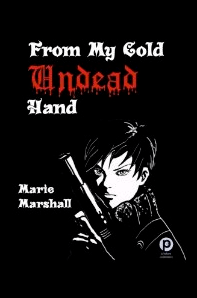 Hard on the heels of news of our client Marie Marshall’s success at Winter Words comes a review from an enthusiastic reader of her YA vampire novel From My Cold, Undead Hand. Here’s an extract:

 a one-time resident of the lovely Vale of Avoca. His poetry is simple, and has been simmered over a low flame of of dry wit. It rhymes a bit too. He reads it out in public, sometimes accompanied by a man with a gong.


 Bookseeker Literary Agency