
 We recently had the opportunity to talk to Marie Marshall about her teen-vampire novelette From My Cold, Undead Hand. The book is scheduled for publication on 15th September, and will be available first of all as a download direct from the publisher. Shortly after that it will be available in Kindle format and print-on-demand from Amazon, and in due course there will be a bookshop launch. So fans of YA and vampire fiction can beat shopgoers to the book by buying pre-launch copies! What is more, early purchasers will be able to claim some bonus extras! This novel marks quite a departure for Marie; although she is well-known in Scotland for her macabre short stories, this is the first time she has tackled the vampire genre. We wondered why, so we asked, and her answers brought out more questions.
Why vampires? Tell us what brought this novel on.
What brought it on was an email from my trusty publisher, asking if I could write a teen-vampire novel. I took that as a request to write one on commission and just hurled myself into it.
There are many well-known writers of vampire stories, from Bram Stoker to Stephenie Meyer, so much so that it is a well-subscribed – some would say over-subscribed – niche of adult, teen, and graphic literature. What makes From My Cold, Undead Hand different?
Honestly I wouldn’t know. I have read Dracula of course, and Joanne Harris’s The Evil Seed, but very little else; oh, and watched Buffy the Vampire Slayer and Angel of course, and many of the old Hammer films. I have always avoided Twilight – you can call that prejudice if you wish. I’m very familiar with vampire images and myths, but I guess I must have absorbed this knowledge through some kind of cultural osmosis!
What I set out to do was just to write a story, most of it set in near-future with dystopic elements but with a nineteenth-century back-story I already had notes for. I cited a couple of obvious influences in the acknowledgments section of the book, but by-and-large my aim was to write a good story, almost as though the vampire theme was incidental. You could say that the true theme of the book isn’t all the vampire action, but the way that young people can get marginalised in an adult world. I think all writers of genre fiction ought to focus on writing the story first of all, and to hell with the conventions of the genre, if you see what I mean.
Tell us about Chevonne Kusnetsov your heroine. You mentioned that you like heroines to be young, strong-minded females.
Isn’t that the definition of ‘heroine’ anyway? I’ll take it that you mean ‘female protagonist’ if we’re going to generalise here. I do tend to write female protagonists that that are young and strong-minded – Eunice and Jelena in Lupa, Angela in The Everywhen Angels – I don’t know of that many major literary female characters who aren’t young and strong-minded. Well, maybe Bridget Jones, and maybe some of the women in the older Mills and Boon novels would be a bit limp, but not even they would be total dead losses. It is, of course, a literary convention to make your protagonist someone admirable, so that the reader can identify readily with that character. That’s reinforced by the first-person narrative.
Chevonne is, I suppose, a tomboy character. I wanted someone with whom young female readers could identify, but who wouldn’t alienate young male readers. I guess in many respects she is asexual. She certainly has other things on her mind than dating and what-have-you. I didn’t want her to be a Bella Swan – she’s closer to Buffy than that, but with a spiky haircut – so any hint of romance is very low key. But it does crop up, just wait and see.
I think one of the main reasons I needed her to be strong-minded was to highlight that theme of marginalisation I mentioned. Without giving too much away, I can tell you that her decisiveness doesn’t actually move the plot along, but rather she is swept along in it. Two of her most important decisions in the story actually have disastrous consequences for people close to her.
Did you know her surname is the Russian equivalent of ‘Smith’, by the way?
Tell us more about Dianne, Chevonne’s friend.
Di is easily led and, true to the theme of the book, easily marginalised, even by someone she loves. There’s a kind of gaucheness about her. There is a good reason why she sticks to Chevonne, and maybe a good reason why Chevonne sticks to her (although I deliberately don’t make that clear). She’s the character in the book whom I most want to cuddle and tell her everything is going to be all right, but of course… ooh… spoilers, spoilers!
I believe that anyone who pre-orders From My Cold, Undead Hand or is quick off the mark buying it, will learn more about Di from some extra material that I have written.
Chevonne’s mother is a bit of a shadowy figure. Are you planning to develop her at some point?
I wasn’t planning to, no. One of the things I did in writing this story was to focus on essentials, via the mind of the protagonist. So much is happening in the story that her mother is hardly on her mind, so she remains shadowy. It’s a part of Chevonne’s character, which is why I guess she doesn’t see the possibly consequences of some of her actions. Add to that I didn’t want Chevonne’s mother to become a kind of Joyce Summers figure (from Buffy), so I deliberately kept her out of most of the story.
Having said that, now that I have written the extra material about Di, I can see the potential for taking figures from the novel and writing short stories about them. Maybe stories not directly connected with the novel.
Every author writes him/herself into the story at some point. Which character do you associate with most, and why?
I don’t do that. What I do is mine my own feelings and put them into characters. I’m not Chevonne, I’m not Di, I’m not Miureen, I’m not Anna Lund.
I did do a bit of kick-boxing when I was young, like Chevonne, though. I’ll say that much.
The dystopian future you describe. Is this based on political views you hold or want to present?
Not particularly. I think that trying to do that spoils a book. For me, John Wyndham’s anti-religious stance coloured his science fiction novels too much, as did C S Lewis’s Christian triumphalism. Even Tressel’s The Ragged Trousered Philanthropists doesn’t quite work. You have to be a Dickens or an Orwell to get away with it. What I did was simply imagine a handful of modern trends and made them a little worse, and that was mainly to create a backdrop and context against which and in which the action could take place.
Which elements of that future, do you feel, will most probably eventually happen?
Well, as they are based on what is already happening… I think the strongest element is the manipulation of government and other institutions by unaccountable forces. The only difference is that they’re not vampires doing it at present. At least I hope not!
You set the action in America. Was there any reason for this? Do you think you have successfully captured a kind of American-ness in the novel?
Well firstly to market the book! Secondly I wanted to have the gun issue as an element. It gave me such a good title, which I appropriated from an NRA slogan. Before you ask, the story is neither pro-gun nor anti-gun. Guns are simply a fact in the novel, and although there are unforeseen consequences upon gun ownership laws from one of the major elements of action, that isn’t moralised upon. I guess anyone with strong pro or anti gun opinions will assume I’m on one side or the other, and I don’t mind if they do if it helps to promote the book!
As for American-ness, well that’s secondary. As I said, I focussed on what was uppermost in the protagonist’s mind, and that wasn’t giving chapter and verse about the Statue of Liberty of the Golden Gate Bridge. To help me with aspects of day-to-day life and expression I had a couple of American ‘beta readers’. I did have a battle with my editor over one vernacular phrase which he said was only heard in the mouths of the ignorant and would pass away. I conceded, but since then I have heard Hilary Clinton use it, so I’m claiming a moral victory!
Is there a future for the storyline? We heard noises of a sequel being under construction?
Yes, a sequel is more than half-completed. Without giving too much away, I have moved it forward, so that what we are going to learn about the storyline from From My Cold, Undead Hand we’ll get in back-story. There will be one important character, however, whom we shall meet again in the sequel. There is also a ‘threequel’ planned, though I have to confess the plot is going to be a bit tricky.
Having had this success with vampire fiction, is it something you are going to stick with beyond the planned trilogy?
Heavens, no! Sorry, I didn’t mean to sound so vehement there, like I’m slamming the door shut on vampire fiction. Obviously if a good story occurs to me I’ll write it. What I really meant was that I had put aside three ideas for other novels – partly written in some cases – in order to write this teen-vampire trilogy. I would like to go back to them, and get back to writing primarily for an adult readership.
Is there an essential difference between writing for adults and writing for young adults?
Oh that actually puts me on the spot. No, there isn’t. You can’t ‘write down’ to either. If anything, though, younger readers are less tolerant of superfluity, more acutely observant of inconsistencies, sharper in their use of their critical faculties – mainly because they haven’t yet been taught how to misuse them.


 To Michael Fry, control of the past, as in the publication of books on Scottish history, has been left too long in academic hands, and has been a one-sided account of social and economic history replete with statistics. His bias was towards culture, society, and politics, in the search for what has kept Scotland Scotland; he has found that when a historian undertakes research he finds things which relate, albeit perhaps as echoes, to today, and that what we recognise are not the products of sudden upheaval but have deep roots.
 Angus Konstam, although principally a maritime historian, has been fascinated by Robert Bruce since reading a ‘Ladybird’ book about him. In his book Bannockburn, according to the event pre-publicity, Konstam ‘debunks some myths about the legend of Robert the Bruce’. He describes the modern popularity of Bruce as ‘a national talisman… wrapped up in romantic guff’. The definition of Bruce’s wars as ‘Wars of Scottish Independence’ was a later one, as are those of a nationalist or a class war, both of which would have been lost on Bruce himself. The thirteenth- and fourteenth-century conflicts were fought to ‘solve purely medieval problems’, and in them even Bruce himself changed sides more than once. Nevertheless, by the time of Bannockburn there was an unprecedented and unfamiliar wave of specifically Scottish patriotism that must have lent something to the subsequent sense of Scottish identity.
 Of the two books foregrounded, it strikes me that Michael Fry’s is probably the more controversial. However both authors were kept busy signing copies of their books after the event. I have to say I was left wanting more time for public discussion with the two authors – to drill down into some apparent contradictions in what Michael Fry said, to challenge Angus Konstam further about whether the myths about Bruce were actually as powerful as he assumed. Joe Farrell did make the point that the pair seemed to have been drawn together simply because they were historians. This was the first time I had attended an event at the Book Festival when I wondered if either of the authors on stage was thinking to himself “If I were Germaine Greer or George R R Martin I would have this stage to myself. Obviously I’m considered second division!” I am happy to give the Edinburgh International Book festival the benefit of the doubt on this issue, because it does what it must to pack so much into its schedule, and by-and-large gets it just right.


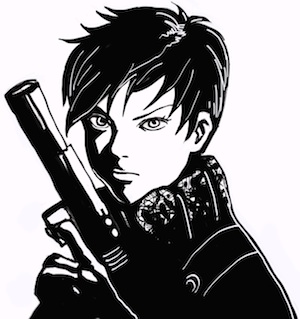 Marie is adept at those strong, female protagonists – Jelena and Eunice in Lupa, Angela in The Everywhen Angels, and now Chevonne Kusnetsov, a girl from New York a few decades in our future, in From My Cold, Undead Hand. The novels launches straight into action, with Chevonne in a darkened library, defending her dying mentor from the attack of a powerful vampire ‘sire’. Spiced here and there with hints of ITpunk and steampunk, and complete with a nineteenth-century sub-plot revealed in an old book, the pace of the novel never flags. It shuts with a bang – readers will blink and say “Huh?” – leaving a perfect springboard for the sequel, KWIREBOY vs VAMPIRE, which is already being written! Ostensibly dealing with the constitutional right of vampires to carry guns, the novel in fact foregrounds how young people are routinely marginalised. So, has she succeeded in avoiding cliché?
 My name is Natalie and I am almost sixteen years old. I didn’t know what to do when two boys asked me out on the same day and I didn’t realise how little I knew about life at the time… but I made my decision and now I have to live with the consequences…

 Solar Wind I: The Mystery of the Solar Wind
 The Everywhen Angels

 Bookseeker Literary Agency